
AI in Healthcare Course in Chennai
- 100% Placement Assistance
- Industry-Led Expert Trainers
- Job-ready curriculum
- Online/Offline Training Sessions


In Collaboration With :
- Live Online Classes starting on 8th, 15th, 22nd & 30th.
Admission Enquiry
100% Placement Assistance
1400+ Hours of Training
500+ Hiring Partners
20000+ Alumni Network
AI for Healthcare Course
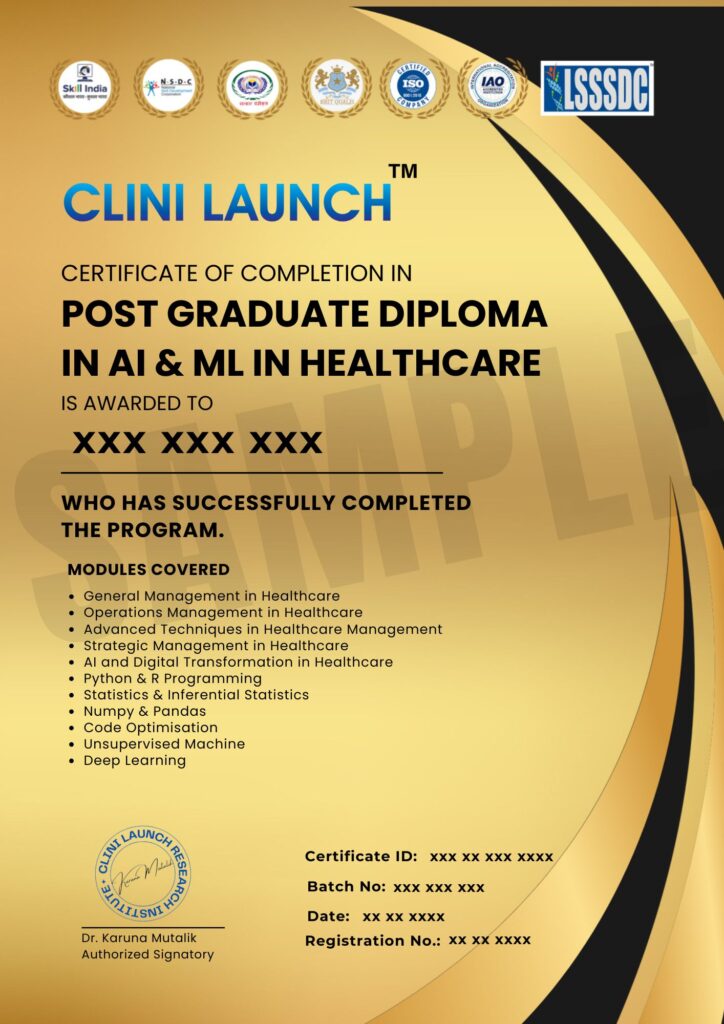
AI Healthcare Course - PG Diploma in AI and ML in Healthcare
Accelerate your career in healthcare with CliniLaunch’s Post Graduate Diploma in AI and ML in Healthcare domain. Learn from industry led expert training, live-online sessions, and study materials with data-driven insights. This comprehensive program bridges the gap between academia and industry demand, empowering students to become a leading professional of AI & ML.



Clinical SAS Online Training
AI and ML in healthcare Course in Chennai
An AI and ML in healthcare course offers a pathway for professionals to leverage technology for patient care. This program delivers as an artificial intelligence in healthcare certificate program provides a comprehensive understanding of how AI and ML in healthcare can be applied to real-world challenges, such as disease diagnosis, personalized treatments plans, and medical image analysis. You will learn to use data-driven techniques, explore ethical considerations, and develop the practical skills needed to implement artificial intelligence in healthcare solutions, enhancing efficiency and improving patient outcomes.
Why is Artificial Intelligence in Healthcare Certificate Program Important?
An AI in healthcare course is crucial because it provides professionals with the specialized knowledge to transform the medical field. Pursuing a medical AI course of an AI in healthcare course equips you with the skills to apply technologies like artificial intelligence and health data analytics to solve complex problems. These healthcare AI courses address the growing need for a workforce capable of leveraging AI and ML in healthcare to improve diagnostics, streamline administrative tasks, and personalized patient care, ensuring that healthcare providers remain at the forefront of innovation.
Globally Recognized Certifications
100% Placement Assistance
Highly Qualified Trainers
20000+ Alumni Network
Job-Oriented Programs
Why choose AI in Healthcare Course in Chennai?
Choosing an AI in healthcare course in Chennai online is a strategic move, offering you access to a city renowned for its medical and technological excellence. Chennai has a robust ecosystem of healthcare institutions and IT companies that makes it an ideal hub to pursue an AI healthcare course. With the perfect blend of academic rigor and industry exposure, students gain practical skills and network with professionals who are actively using artificial intelligence and healthcare technology. By enrolling in an AI for healthcare course, you will gain the expertise to make a meaningful impact on patient care and public health.
- Industry Integration
- Chennai’s dual strength in IT and medicine provides practical, real-world projects for a healthcare artificial intelligence course.
- Expert Faculty
- Learn from a blend of data scientists and medical professionals who understand both technology and its application in artificial intelligence and health.
- Robust Curriculum
- The curriculum is tailored to address the needs of the Indian healthcare market, providing relevant skills.
- Career Opportunities
- An AI healthcare course in Chennai positions you for a strong job market in a city with a high demand for tech and healthcare professionals.
Top Reasons to Join AI ML in Healthcare Course
Pursuing an AI in healthcare online course is a strategic move for professionals looking to future-proof their careers and contribute to a transformative field. An AI for healthcare course provides the specialized skills needed to address complex challenges in modern medicine. Following are the top reasons to join AI ML in healthcare course from Clini Launch:
AI algorithms can analyze vast datasets of medical images (X-rays, MRIs, CT scans) with a level of precision and speed that augments the capabilities of human radiologists. A medical artificial intelligence course teaches you how to develop these powerful diagnostic tools.
An Artificial Intelligence Course for Healthcare Professionals enables you to leverage data from patient history, genetics, and lifestyle to create personalized treatment plans, moving beyond a one-size-fits-all approach. This focus on Artificial Intelligence and healthcare is revolutionizing precision medicine.
AI automates routine but time-consuming tasks like appointment scheduling, medical record management, and billing. By taking a healthcare artificial intelligence course, you can learn to implement these solutions, reducing administrative burdens and preventing staff burnout.
The drug development process is costly and lengthy. AI and machine learning can analyze molecular structures and predict compound effectiveness, significantly shortening the time it takes to bring new drugs to market. A Healthcare AI Certification validates your ability to contribute to this cutting-edge research.
A key component of AI and healthcare courses is predictive analytics. You learn to analyze health data to identify patients at high risk of developing a disease, allowing for early intervention and preventive care. This capability saves lives and reduces long-term healthcare costs.
An AI healthcare course provides you with the skills to analyze massive volumes of research data, clinical trial results, and medical literature much faster than traditional methods, accelerating scientific discoveries and medical breakthroughs.
Medical Artificial Intelligence course curricula often cover the use of AI in robotic-assisted surgery. AI can guide robots to perform complex, delicate procedures with higher precision than is possible with the human hand, improving surgical outcomes.
With an abundance of digital health data, the ability to make data-driven decisions is paramount. An AI for healthcare course teaches you to use Artificial Intelligence and health data to offer real-time recommendations based on clinical guidelines, reducing medical errors.
The global market for AI in healthcare is projected to grow significantly. Completing an AI in healthcare online course or one of the many Healthcare AI Courses opens up diverse, high-paying roles such as a Medical Data Scientist, AI Engineer, or a Clinical Decision Support Specialist.
An AI in healthcare online course not only focuses on technical skills but also addresses critical ethical considerations, such as data privacy, algorithmic bias, and accountability. This ensures you develop solutions that are both effective and responsible, fostering trust in technology.
FREE Career Counselling
Why Student Choose Us?
Take the next step towards AI and ML in healthcare
20000+
Professional Network
40%
Average Salary Hike
500+
Hiring Partners
5 LPA
Highly Qualified Trainers
Choose Your Role
Pursuing a course in AI and ML in healthcare opens a wide range of specialized and high-demand job opportunities. These roles leverage Artificial Intelligence and healthcare data to improve patient outcomes, optimize operations, and advance medical research. A medical artificial intelligence course or a healthcare AI certification validates your expertise, making you highly competitive.
Medical Data Scientist
Clinical Informatics Specialist
AI Product Manager (Healthcare)
AI Research Scientist
Healthcare AI Engineer
Natural Language Processing (NLP) Engineer
Robotics Engineer (Medical)
Career Opportunities after AI ML in Healthcare Course
Job roles
- Medical Data Scientist
- Machine Learning Engineer
- AI Diagnostics Specialist
- Healthcare AI Consultant
- AI Product Manager
Hiring Industries
- Hospitals and Healthcare
- Pharmaceutical and Biotechnology
- HealthTech Startups
- Medical Device Manufacturers
- Consulting Firms
Work Locations
- Bangalore
- Mysore
- Chennai
- Hyderabad
- Oversees
100+ Leading CROs And Pharma Companies



Frequently Asked Questions
A medical AI course focuses on teaching a blend of technical and domain-specific skills. Students learn core concepts of machine learning and deep learning, specifically tailored for medical data. The curriculum includes image analysis for diagnostics, natural language processing for electronic health records, and predictive modeling to forecast patient outcomes.
The ideal candidate for a medical AI course is someone with a background in either the medical or technical fields. This includes medical professionals like doctors and researchers who want to understand and apply AI, as well as data scientists and programmers who want to specialize in the complex and regulated healthcare domain.
Completing a medical AI course can lead to several career opportunities. You can work as an AI specialist in hospitals, as data scientist for pharmaceutical companies, or as researchers in academic institutions. They may also find roles in health tech startups that develop AI-powered diagnostic tools, patient monitoring systems, and other innovative solutions.
The primary application of AI for medical use cases is to enhance diagnostic accuracy and efficiency. AI algorithms can analyze vast amounts of medical data, such as radiological images and patient health records, to identify subtle patterns that may be difficult for humans to detect. This assists clinicians in making faster and more precise diagnoses.
AI for medical applications improve patient care by enabling personalized treatment plans. By analyzing a patient’s genetic information, lifestyle data, and medical history, AI can predict how they will respond to different treatments. This allows doctors to select the most effective therapy and dosage for an individual, leading to better outcomes.
Yes, AI for medical systems is increasingly being used in the day-to-day operations of hospitals. Beyond diagnostics, they are employed to optimize administrative tasks, manage patient scheduling, and predict hospital bed availability. These applications streamline workflows, reduce costs, and allow healthcare staff to focus more on direct patient interaction.
While often used interchangeably, AI and machine learning in healthcare have distinct roles. AI is the broader field of creating systems that can perform tasks requiring human-like intelligence, such as diagnosing a disease. Machine learning is a specific subset of AI that uses algorithms to learn from data, which is how AI systems are trained to improve their performance over time.
AI and machine learning in healthcare are revolutionizing drug discovery by significantly accelerating the process. Algorithms can analyze massive datasets of molecular structured and biological targets to identify potential drug candidates. This predictive modeling helps researchers prioritize the most promising compounds, reducing the time and cost associated with developing new medicines.
The use of AI and machine learning in healthcare raises several important ethical considerations. These include data privacy and security, as highly sensitive patient data is used to train models. There is also the risk of algorithmic bias, where models trained on non-diverse datasets may lead to inequitable health outcomes for certain demographic groups.
The primary benefits of using AI in healthcare are improved efficiency, accuracy, and accessibility. AI systems can automate repetitive tasks, such as data entry and administrative work, freeing up medical professionals. They also enhance the precision of diagnostics and can make healthcare services more accessible through telemedicine platforms and AI-powered assistants.
AI in healthcare assists with patient monitoring through the use of smart devices and wearables. AI algorithms can analyze real-time data from these devices to predict health events, such as a heart attack or a diabetic episode. This allows for proactive intervention by healthcare providers, which can prevent serious complications and improve patient safety.
No, AI in healthcare is not designed to replace doctors and nurses. Instead, it serves as a powerful tool to augment their capabilities. AI can provide a second opinion on a diagnosis, automate routine tasks, and help manage large volumes of data. This allows medical professionals to focus on the human aspects of care, such as patient empathy, complex decision-making, and direct treatment.
The duration of an AI medicine course can vary widely depending on the level of study. However, Clini Launch offers AI and ML in healthcare courses that last 12 months as it is a PG Diploma program.
Prerequisites for an AI medicine course often include a strong academic background in either computer science, statistics, or a healthcare-related field. A bachelor’s degree in a relevant subject is typically required. While this Pg Diploma course is designed for beginners, many advanced programs require prior knowledge of programming languages like Python and a foundational understanding of machine learning.
In an AI medicine course, you will learn specific applications such as using deep learning for medical image analysis to detect tumors, applying natural language processing to extract data from unstructured electronic health records, and building predictive models to forecast patient survival rates. The training is highly practical, with a focus on real-world medical use cases.
AI in healthcare research dramatically speeds up scientific discovery by analyzing complex, large-scale datasets that would take human researcher years to process. AI can identify patterns and correlations in genetic data, clinical trial results, and patient records, leading to new insights into disease mechanisms and potential new treatments much faster than traditional methods.
Some examples of AI in healthcare research include the use of machine learning to predict the effectiveness of new drug compounds, analyzing genomic data to understand disease susceptibility, and creating virtual models to simulate drug interactions. AI is also used to optimize clinical trial designs, making them more efficient and cost-effective.
AI in healthcare research assists with identifying disease biomarkers by analyzing patient data from various sources, including blood tests, genetic profiles, and medical images. AI algorithms can find unique patterns or signatures that are indicative of a specific disease, often at a very early stage. This can lead to the development of new diagnostic tests and personalized medicine strategies.
AI in health and medicine is making a significant impact on diagnostics by analyzing medical images with high accuracy. For example, AI algorithms can review X-rays, CT scans, and MRIs to detect signs of cancer or other diseases, sometimes with higher speed and accuracy than human radiologists. This is particularly useful in areas with a shortage of specialists.
In telemedicine, AI in health and medicine plays a crucial role by supporting virtual consultations. AI powered chatbots can provide initial assessments of symptoms, answer patient questions, and even help with scheduling appointments. This improves the efficiency of virtual care, ensuring patients get the right information and resources quickly.
AI in health and medicine is being used to personalize treatment by creating bespoke plans for individual patients. AI algorithms analyze a person’s unique health data, including their genetic makeup and lifestyle, to predict how they will respond to different medications or therapies. This allows doctors to tailor treatment to the patient, increasing the likelihood of a positive outcome.
The main applications of artificial intelligence AI in healthcare include patient care and administrative tasks. In patient care, AI is used for enhanced diagnostics and personalized treatment recommendations. For administrative purposes, it is used for automating tasks like data entry, medical coding, and insurance claims processing, which significantly improves operational efficiency.
Artificial intelligence AI in healthcare improves clinical decision-making by providing a layer of data-driven insights. AI systems can synthesize information from a patient’s electronic health records, lab results, and real-time monitoring data. This allows clinicians to access a comprehensive view of the patient’s health, helping them make more informed and accurate decisions.
Artificial intelligence AI in healthcare plays a crucial role in enhancing patient safety. AI systems can be used to predict the risk of a patient developing a complication, such as a hospital-acquired infection. They can also audit prescriptions to check for potential drug interactions or incorrect dosages, thereby reducing the risk of medical errors.
Artificial intelligence in medical diagnosis is widely used in radiology to analyze medical images. AI algorithms can detect and highlight anomalies, such as tumors or fractures, on X-rays, CT scans, and MRIs. This helps radiologists to quickly identify potential issues and provides a second check, which can lead to a more accurate and rapid diagnosis.
In specific, data-rich tasks, artificial intelligence in medical diagnosis has shown the potential to be more accurate than a human doctor. For example, AI has demonstrated a higher success rate in diagnosis skin cancer from images and detecting signs of certain retinal diseases. However, AI lacks the contextual reasoning and holistic understanding of a patient that a human doctor possesses.
The limitations of artificial intelligence in medical diagnosis include the need for massive, high-quality datasets for training. If the training data is biased or incomplete, the AI can make inaccurate diagnoses. Additionally, AI systems can struggle with complex or rate cases that fall outside of the patterns they have been trained on, and they lack the ability to interact with a patient directly.
ML in healthcare can be used to predict disease outbreaks by analyzing a combination of data points, including patient records, social media activity, and environmental factors. By identifying patterns and trends in this data, machine learning models can forecast the spread of a virus or disease, allowing public health officials to take proactive measures to contain it.
Some real-world examples of ML in healthcare include Google’s AI model that can detect diabetic retinopathy from eye scans and Microsoft’s AI that helps predict a patient’s risk of readmission to the hospital. Another example is the use of ML to personalize patient-specific drug diagnoses based on their individual health data.
ML in healthcare contributes to personalized medicine by analyzing a person’s unique biological data, such as their genomics and proteomics. Machine learning models can predict how a patient will respond to a specific treatment based on this information, which helps doctors select the most effective therapy and dosage for that individual, moving away from a one-size-fits-all approach.
The key ethical challenges associated with AIML in healthcare include data privacy, accountability for errors, and algorithmic bias. Since patient data is extremely sensitive, ensuring its security is paramount. If an AI system makes an incorrect diagnosis, it can be unclear who is responsible, and if the data used to train the model is not diverse, the AI may perform poorly on certain patient population.
AIML in healthcare improves the efficiency of clinical trials by analyzing large datasets to identify the most suitable candidates for a trial. AI can also predict potential side effects and outcomes, which helps in optimizing the trial design. By automating these processes, AI reduces the time and cost required to bring new medical treatments to market.
Yes, AIML in healthcare can be used to predict patient outcomes with a high degree of accuracy. By analyzing a patient’s health history, vital signs, and risk factors, machine learning models can forecast a patient’s likelihood of recovery, potential complication, or readmission to the hospital. This predictive capability allows healthcare providers to intervene proactively.
The main benefits of artificial intelligence in health include the ability to analyze complex data sets, improve diagnostics, and streamline administrative workflows. By automating tasks and providing data-driven insights, AI enhances the efficiency of healthcare systems, allowing medical staff to focus more on patient care and reducing the potential for human error.
Artificial Intelligence in Health is used for remote monitoring through smart devices and wearables. AI algorithms can analyze real-time data from these devices, such as heart rate, blood pressure, and sleep patterns. If a patient’s health metrics show a deviation from the norm, the AI can alert a healthcare provider, enabling them to intervene before a health crisis occurs.
Artificial Intelligence in Health improves the patient’s experience by making healthcare more personalized and accessible. AI-powered chatbots and virtual assistants can help patients with scheduling appointments and answering basic medical questions. Additionally, AI can help in personalizing treatment plans and providing patients with timely information, which can lead to better engagement and improved health outcomes.
The main role of medicine artificial intelligence in medical imaging is to assist clinicians in a faster and more accurate diagnosis. AI algorithms are trained to analyze vast numbers of scans, such as X-rays and MRIs, to automatically detect abnormalities, such as tumors or organ dysfunction. This provides a valuable second opinion and can significantly speed up the diagnostic process.
Medicine artificial intelligence aids in drug discovery by analyzing complex biological and chemical data to identify new potential drug targets and molecules. AI models can predict the effectiveness of new compounds and their potential side effects before they enter human trials, drastically reducing the time and cost of Phamaceutical development.
The most common tools for medicine artificial intelligence include machine learning algorithms, deep learning neural networks, and natural language processing (NLP). These tools are used to build applications for image analysis, predictive analytics, and data extractions from electronic health records, forming the backbone of AI-powered medical solutions.
AI for health care plays a crucial role in managing chronic diseases by analyzing data from wearable devices and electronic health records to provide personalized insights. AI models can predict potential health crises, recommend lifestyle adjustments, and help patients and doctors manage conditions like diabetes or heart disease with greater precision and proactivity.
Yes, AI for health care is being used to make clinical trials more efficient and successful. Ai can help identify eligible patients, analyze trial data in real-time to adjust trial design, and even predict the likelihood of a new drug’s success. This significantly reduces the time and cost required for drug development and testing.
Artificial Intelligence in medical field assists in patient triage by analyzing patient data and symptoms to prioritize those who need immediate attention. In emergency rooms, AI can quickly process information to identify patients with life-threatening conditions, helping medical staff focus their resources where they are most critically needed.
Some examples of Artificial intelligence in medical field include diagnostic tools that analyze medical images for signs of cancer, predict models that forecast patient readmission risk, and AI-powered robots that assist in surgical procedures. AI is also used to automate administrative tasks like patient scheduling and billing.
Artificial intelligence in medical field is impacting surgical procedures by enhancing precision and control. AI-powered robots can assist surgeons in delicate operations, providing greater stability and accuracy than a human hand. AI can also analyze real-time patient data during a procedure to provide the surgical team with critical information.
Machine learning’s role in healthcare and machine learning research is to discover new patterns in biological and clinical data. By applying sophisticated algorithms, researchers can identify gene mutations linked to diseases, predict how patients will respond to certain therapies, and find new biomarkers for early disease detection, accelerating the pace of medical innovation.
Machine learning in healthcare and machine learning improves disease diagnosis by analyzing complex data from various sources, such as medical images, lab results, and patient symptoms. It can detect subtle patterns that are difficult for human perception, assisting doctors in making faster and more accurate diagnoses, especially in fields like radiology and pathology.
Predictive models from machine learning in healthcare and machine learning can benefit patients by enabling proactive care. By analyzing a patient’s data, these models can forecast their risk of developing a chronic condition or experiencing a medical event. This allows healthcare providers to intervene early with preventive care, personalized wellness plans, or lifestyle recommendations to avoid a health crisis.
Reviews From Our Happy Students
Upskilling does make a difference. Graduates speak out.Hear what our students and professionals are saying about their upskilling journey with CliniLaunch.
Posted on
- What Our Students Say
The AI and machine learning in healthcare course at Clini Launch is a highly recommended and worthwhile investment. The program’s training in artificial intelligence and healthcare has been instrumental in helping graduates secure leading roles in top hospitals and HealthTech companies across India.
- Why did the students choose Clini Launch?
- Industry-relevant Curriculum
- Expert Faculty and Mentors
- Extended Placement Support
- Flexible Learning/Online Training